



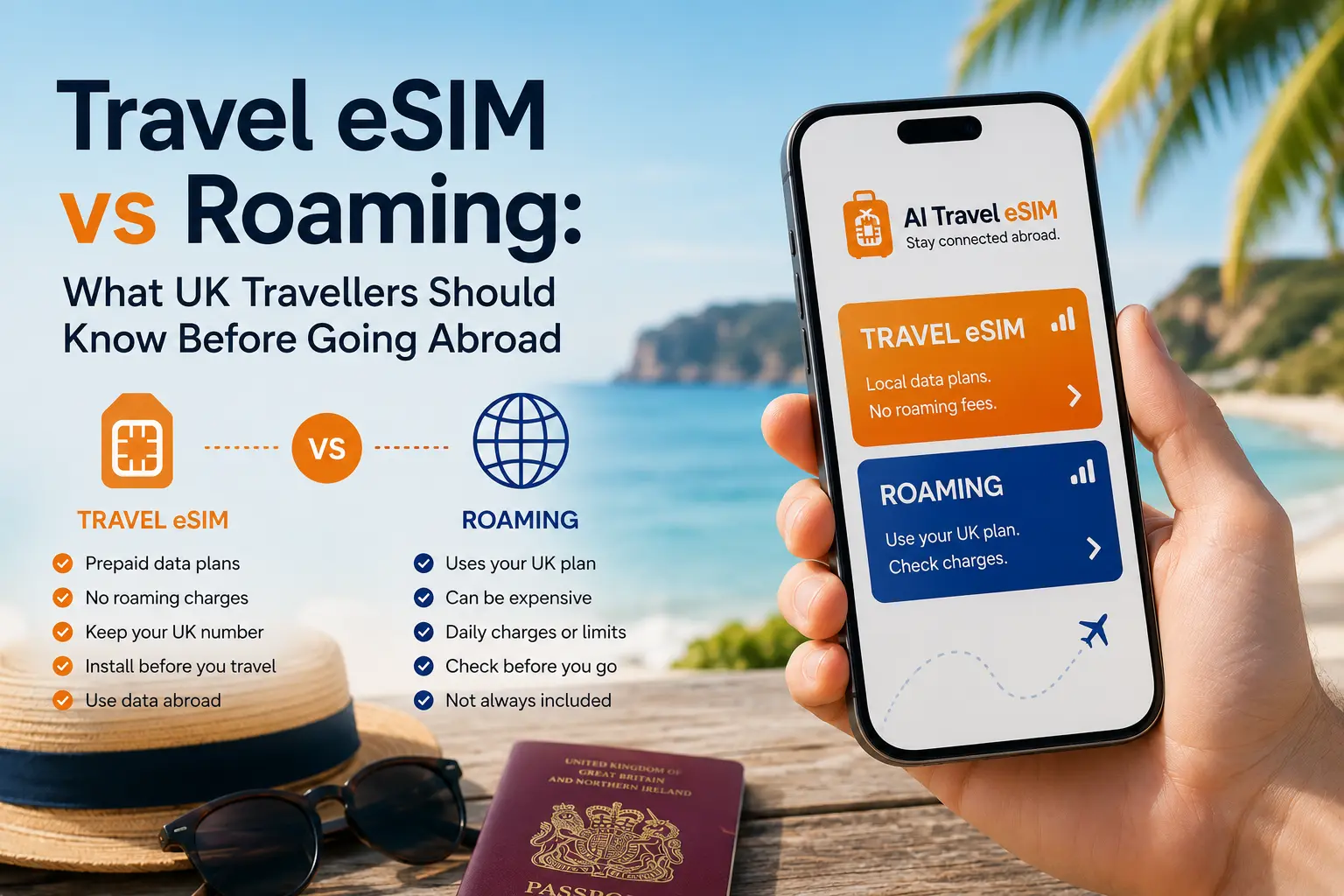
Travel eSIM vs roaming: which is better for your holiday?
Before you go abroad, one of the most useful things to sort out is mobile data.
You may not think about it while you are packing your suitcase, but the moment you land, your phone becomes essential. You might need it for airport transfers, hotel directions, Google Maps, WhatsApp, Facebook Messenger, Instagram, online tickets, banking apps, translation tools, restaurant bookings and flight updates.
The question is: should you use roaming through your normal UK mobile provider, or should you buy a travel eSIM before you go?
The answer depends on your phone, your destination, your UK mobile plan and how much data you expect to use.
Roaming can be convenient if it is included in your plan and gives you enough data. But if roaming is expensive, limited or unclear, a travel eSIM can be a simpler way to stay connected abroad.
With AI Travel eSIM, you can arrange your travel data by chat. Message the bot on WhatsApp, Facebook Messenger or Instagram chat, tell it where you are travelling, choose a suitable plan, pay in chat, and receive your installation link and QR code.
No separate eSIM app. No airport SIM queue. No physical SIM card to swap.
Quick answer: travel eSIM or roaming?
For many UK travellers, a travel eSIM is a good choice if you want more control over your mobile data abroad.
A travel eSIM may be better if:
- Your UK provider charges extra for roaming
- Your roaming allowance is small
- You are travelling outside included roaming zones
- You want a separate data plan for your trip
- You mainly need data for maps, messages and travel apps
- You want to avoid airport SIM card queues
- You do not want to download another eSIM app
- You want to keep your normal UK SIM in your phone
Roaming may be fine if:
- Your UK plan includes roaming in your destination
- You have enough data included
- You understand any fair usage limits
- You are happy with the daily charge, if one applies
- You do not want to install anything new
The safest approach is to check your UK roaming policy before travelling, then compare it with a travel eSIM option.
What is roaming?
Roaming is when your normal UK SIM connects to a mobile network in another country.
For example, if you travel from the UK to Spain, France, Turkey or the USA and continue using your normal mobile plan, your phone may roam on a local network.
This can let you use calls, texts and mobile data abroad, depending on your provider and plan.
The convenient part is that roaming uses your existing SIM and phone number. You do not need to install anything new.
The less convenient part is that roaming charges, data limits and fair usage rules can vary a lot. Some UK mobile plans include roaming in certain countries, while others charge daily fees or have strict limits.
That is why it is important not to assume roaming is free or included.
What is a travel eSIM?
A travel eSIM is a digital SIM that gives you mobile data abroad.
Instead of putting a physical SIM card into your phone, you install the eSIM digitally using an installation link, QR code or setup details.
Most travel eSIMs are data-only. That means they are mainly used for internet access rather than traditional calls and texts.
For most holidaymakers, that is exactly what they need. A data-only travel eSIM can be used for:
- Facebook Messenger
- Google Maps
- Apple Maps
- Gmail
- Outlook
- Hotel apps
- Airline apps
- Taxi apps
- Banking apps
- Translation apps
- Browsing and search
On many compatible phones, you can keep your normal UK SIM active and use the travel eSIM for mobile data abroad.
Why UK travellers should check roaming before every trip
Years ago, many UK travellers got used to using their normal mobile allowance in Europe without extra roaming charges.
That is no longer something you should assume.
Surcharge-free roaming in EU and EEA countries is no longer guaranteed for UK travellers, and mobile providers can have different policies depending on your plan, destination and contract.
Some providers still include roaming on certain tariffs. Others may charge a daily fee, apply fair usage limits, reduce speeds, or only include roaming in selected destinations.
This means two people travelling to the same country could have very different roaming costs depending on their mobile provider.
Before you travel, check:
- Is your destination included in your roaming plan?
- Is roaming free, charged daily or charged per use?
- How much data can you use abroad?
- Are there fair usage limits?
- What happens if you go over the allowance?
- Is hotspot or tethering allowed?
- Does your plan cover every country you are visiting?
If the answer is unclear, a travel eSIM may give you a more controlled option.
Travel eSIM vs roaming: the main differences
Here is the simple comparison.
| Feature | Travel eSIM | Roaming |
|---|---|---|
| How it works | Digital travel data plan installed on your phone | Your UK SIM connects to foreign networks |
| Best for | Controlled mobile data abroad | Convenience if included in your plan |
| Setup | Requires eSIM-compatible unlocked phone | Usually works automatically |
| App download | Not needed with AI Travel eSIM | Not usually needed |
| Phone number | Usually data-only, no new number needed for apps | Uses your normal UK number |
| Cost control | You choose a travel data plan | Depends on your UK provider’s roaming policy |
| Physical SIM | No physical SIM card | Uses your existing SIM |
| Good for maps and apps | Yes | Yes, if roaming data is available |
| Risk of unexpected charges | Lower if set up correctly | Can be higher if roaming costs are unclear |
| Best buying route | Before you travel | Through your existing mobile provider |
Neither option is always better for everyone. The best choice depends on your trip.
When roaming may be the better option
Roaming can be the easiest option if your UK mobile plan already includes generous roaming for your destination.
For example, if your provider includes the country you are visiting, gives you enough data, and does not charge extra, roaming may be perfectly fine.
Roaming may also be useful if you need traditional calls and texts through your normal UK number while abroad.
Some travellers prefer roaming because they do not need to install anything new. They can simply land, switch on their phone and use it.
However, this only works well if you understand the charges and limits before you go.
If you are unsure what your provider includes, check before travelling. Do not wait until you land.
When a travel eSIM may be the better option
A travel eSIM may be better if you want a clear, separate data plan for your trip.
It can be especially useful if:
- Your UK roaming is expensive
- Your roaming allowance is too small
- You are travelling outside Europe
- You are visiting multiple destinations
- You want to keep roaming off on your UK SIM
- You mainly need data rather than calls and texts
- You want mobile data ready when you arrive
- You do not want to buy a local SIM card abroad
For holidays, a travel eSIM often makes sense because most people mainly need mobile data.
You can use data for maps, messaging, tickets, bookings, taxis, banking, translation and social media.
You may not need a new phone number at all.
The cost difference: travel eSIM vs roaming
The cost difference depends on your provider, destination and data usage.
Some UK mobile plans include roaming at no extra cost in certain destinations. Others may charge a daily fee or limit how much data you can use.
A travel eSIM is usually bought separately for a specific destination or region. You choose a plan based on how much data you need and how long you are travelling.
The advantage is control. You know what travel data plan you have chosen before you go.
The important thing is to compare like for like.
Before choosing, ask yourself:
- How much would roaming cost for the full trip?
- How much data would I actually get?
- Would a daily roaming fee add up?
- Is my destination included?
- Will I need more data than my roaming allowance gives me?
- Would a travel eSIM be simpler?
For a short trip, roaming may be fine if the daily fee is low. For a longer holiday, the cost can add up quickly.
Why data roaming settings matter
One confusing part of using a travel eSIM is the word “roaming”.
When people hear “data roaming”, they often think it should always be switched off abroad.
That is true for your normal UK SIM if you are trying to avoid roaming charges.
But your travel eSIM may need data roaming switched on to work correctly.
A common setup is:
- UK SIM: data roaming off
- Travel eSIM: data roaming on, if the eSIM instructions require it
- Mobile data line: set to the travel eSIM
- Calls and texts: keep on your UK SIM if needed
This helps your phone use the travel eSIM for mobile data instead of accidentally using roaming through your UK SIM.
Always follow the instructions provided with your eSIM, because settings can vary by phone and plan.
Can you keep your UK SIM active with a travel eSIM?
In most cases, yes, as long as your phone supports eSIM and dual SIM.
This is one of the main benefits of a travel eSIM.
You can usually keep your UK SIM in your phone for your normal number, while using your travel eSIM for mobile data abroad.
That means you may still be able to receive important texts, such as bank verification codes, airline messages or travel alerts, while using your travel eSIM for internet access.
Your apps can continue working over mobile data, including WhatsApp, Facebook Messenger, Instagram, Google Maps and email.
You are not replacing your whole phone setup. You are simply adding a travel data plan.
Travel eSIM vs local SIM card
A local SIM card is another option when travelling abroad.
You can often buy a physical SIM in your destination, sometimes from an airport kiosk, mobile shop or supermarket.
This can work, especially for longer trips. But for holidays, it can be inconvenient.
You may need to:
- Find a shop when you arrive
- Compare unfamiliar plans
- Show ID or passport details
- Deal with a language barrier
- Remove your UK SIM card
- Keep your original SIM safe
- Wait for the local SIM to activate
- Work out the local network’s setup instructions
A travel eSIM avoids most of that. There is no physical SIM card, no shop visit and no SIM tray to open.
You can organise it before you travel and arrive with your data ready.
Travel eSIM without downloading another app
Many eSIM providers ask you to download their app, create an account and manage your plan inside their dashboard.
That can be fine if you travel regularly and like using a dedicated app.
But if you are going on holiday, you may not want another app just to sort your mobile data.
AI Travel eSIM is designed to be simpler.
You can buy by chat through:
- Facebook Messenger
- Instagram chat
The process is straightforward:
- Message the bot.
- Tell it where you are travelling.
- Choose a suitable data plan.
- Pay in chat.
- Receive your installation link and QR code.
- Install your travel eSIM and follow the setup instructions.
No separate eSIM app. No extra phone clutter. No complicated marketplace.
How much data do you need abroad?
The right amount of data depends on your trip and how you use your phone.
As a rough guide:
| Traveller type | Typical use abroad | Suggested data |
| Light user | Maps, WhatsApp, email and basic browsing | 1GB to 3GB |
| Average holidaymaker | Maps, messaging, Instagram, bookings, browsing and travel apps | 3GB to 5GB |
| Heavy user | Video calls, uploads, TikTok, hotspot and regular browsing | 10GB or more |
You can reduce data usage by using trusted Wi-Fi at your hotel, downloading offline maps, turning off automatic app updates and avoiding video streaming on mobile data.
If you are not sure what you need, AI Travel eSIM can help. Tell the bot where you are going, how long you are away for and how you normally use your phone.
Travel eSIM vs roaming for Europe
For European holidays, the best option depends on your UK mobile plan.
Some UK travellers still have plans that include roaming in parts of Europe. Others may have to pay daily charges or follow fair usage limits.
A travel eSIM can be useful for Europe if:
- Your provider charges for EU roaming
- Your roaming allowance is limited
- You are visiting multiple countries
- You want a separate data plan
- You want to avoid using your UK SIM for mobile data abroad
If your UK provider includes plenty of roaming data for your destination, you may not need a travel eSIM.
The key is to check before you go.
Travel eSIM vs roaming outside Europe
Outside Europe, roaming can often become more expensive or more limited, depending on your provider and destination.
Countries such as the USA, Turkey, UAE, Thailand, Japan, Australia, Egypt and Morocco may have very different roaming rules from European destinations.
A travel eSIM can be especially useful for these trips because you can buy data for the country or region before you travel.
This helps you avoid relying on expensive roaming, airport SIM shops or public Wi-Fi.
Before travelling outside Europe, always check your provider’s roaming charges carefully.
Which option is better for families and groups?
A travel eSIM can be useful for families and groups because each person can have their own data plan.
This can be simpler than relying on one person’s roaming, hotspot or hotel Wi-Fi.
It also means each traveller can use maps, messages and tickets independently.
That is helpful if people split up during the day, go to different attractions, or need to contact each other while abroad.
If one person is organising the trip, they can also help others check whether their phones are eSIM compatible before buying.
What to check before choosing a travel eSIM
Before buying a travel eSIM, check:
- Your phone supports eSIM
- Your phone is unlocked
- Your destination is covered
- You have selected the right country or region
- You know roughly how much data you need
- You have Wi-Fi available for installation
- You understand which SIM should be used for mobile data
- You know whether data roaming needs to be on for the eSIM
Many modern iPhones, Samsung Galaxy phones, Google Pixel phones and other newer devices support eSIM, but not every phone does.
If you are unsure, look in your phone settings for Add eSIM, Add Mobile Plan, SIM Manager or an EID number.
What to check before using roaming
Before relying on roaming, check:
- Is your destination included in your plan?
- Are there daily charges?
- How much data can you use?
- Are there fair usage limits?
- What happens if you exceed your allowance?
- Are calls and texts included?
- Is hotspot allowed?
- Can you set a spending cap?
- Will your provider send roaming alerts?
It is better to check this before you travel than to discover charges after you arrive.
So, should you choose a travel eSIM or roaming?
Choose roaming if your UK provider includes your destination, gives you enough data, and you are happy with any charges or limits.
Choose a travel eSIM if you want a separate data plan, more control, and a simple way to stay connected abroad without depending entirely on your UK roaming allowance.
For many holidaymakers, the travel eSIM option feels more predictable.
You know what you have bought, you can install it before you go, and you can use it for the apps you rely on every day.
Buy your travel eSIM by chat
AI Travel eSIM makes mobile data abroad simple.
Message the bot on WhatsApp, Facebook Messenger or Instagram chat, tell it where you are travelling, choose a suitable plan, pay in chat, and receive your installation link and QR code.
No separate eSIM app. No airport SIM queue. No physical SIM card to swap.
Just simple travel data, ready before you go abroad.
FAQs
Is a travel eSIM better than roaming?
It depends on your UK mobile plan and destination. If roaming is included and gives you enough data, it may be fine. If roaming is expensive, limited or unclear, a travel eSIM can give you more control.
Is roaming still free in Europe for UK travellers?
Not always. Some UK providers include EU roaming on certain plans, but surcharge-free roaming is no longer guaranteed. Always check your provider’s current policy before travelling.
Can I use a travel eSIM and keep my UK SIM?
In most cases, yes, if your phone supports eSIM and dual SIM. You can usually keep your UK SIM active and use the travel eSIM for mobile data abroad.
Should data roaming be on or off with a travel eSIM?
Usually, data roaming should be off on your UK SIM to avoid unwanted charges. Your travel eSIM may need data roaming switched on to work. Follow the instructions provided with your eSIM.
Do I need a travel eSIM if my UK plan includes roaming?
Not always. If your UK plan includes enough roaming data for your destination, you may not need one. A travel eSIM is useful if your roaming is limited, expensive or unclear.
Can I use WhatsApp with a travel eSIM?
Yes. WhatsApp works over mobile data, so you can usually continue using your normal WhatsApp account with a travel eSIM.
Can I use Facebook Messenger and Instagram with a travel eSIM?
Yes. A travel eSIM provides mobile data, so Facebook Messenger, Instagram and other internet-based apps can work while you are abroad.
Does a travel eSIM include calls and texts?
Most travel eSIMs are data-only. They are mainly used for internet access, maps, apps and messaging services rather than traditional calls and texts.
Do I need to download an app to buy a travel eSIM?
With AI Travel eSIM, no separate eSIM app is needed. You can arrange your travel eSIM through WhatsApp, Facebook Messenger or Instagram chat.
How do I avoid roaming charges abroad?
Check your UK provider’s roaming policy before travelling, turn off data roaming on your UK SIM if needed, use Wi-Fi where appropriate, and consider using a travel eSIM for mobile data abroad.